
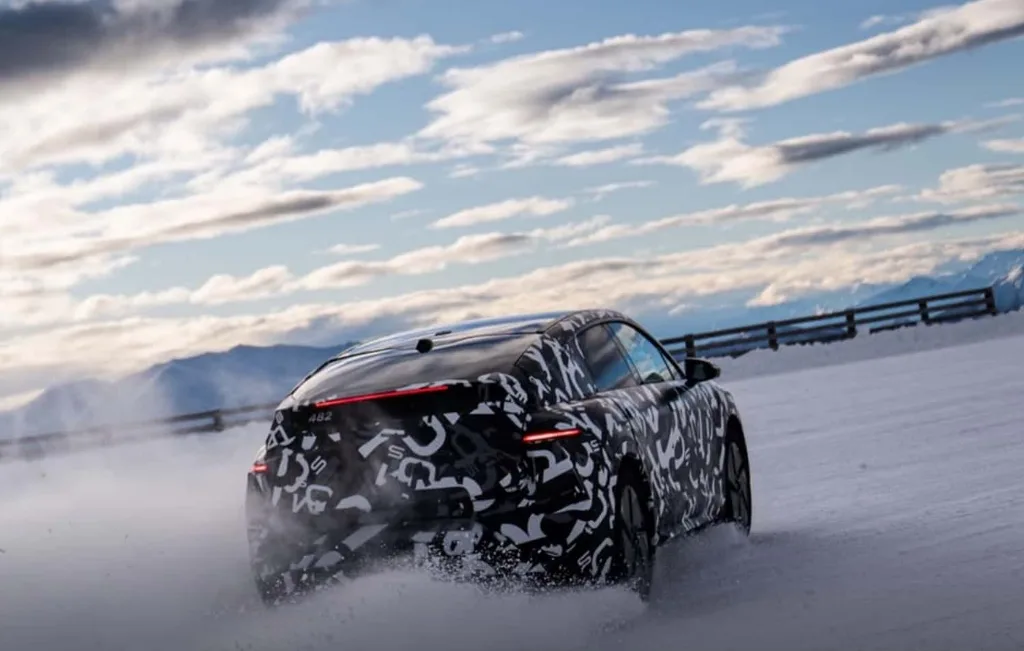
Lucid needs the Cosmos to work. Until now, the American brand has built its image around the Air and Gravity, two high-end electric vehicles with advanced technology, but also high prices, complex manufacturing and limited scalability. The Cosmos changes that approach. It will be a mid-size electric SUV aimed at the premium volume market and designed to compete with cars such as the Tesla Model Y, BMW iX3, electric Mercedes-Benz GLC and the future Volvo EX60.
The first official images show a low-slung SUV with a sharply sloping roofline, closer to a coupe-style crossover than a conventional family SUV. At the rear, there are two horizontal LED taillights, a wide third brake light positioned low on the rear glass and an almost horizontal rear window. It is an attractive design solution, but one that could limit rearward visibility, meaning Lucid will probably rely heavily on cameras and driver-assistance systems.
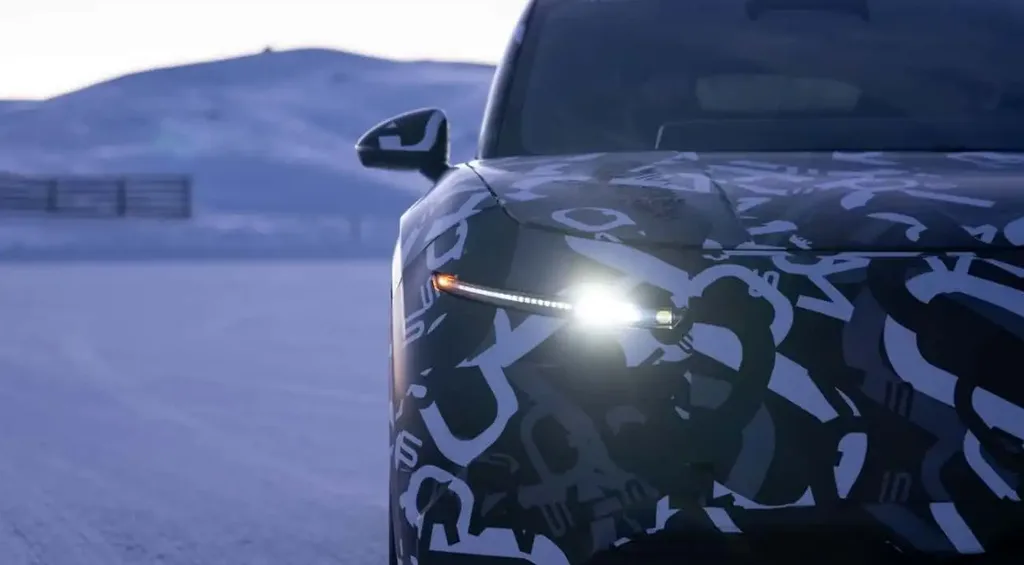
The front end also follows Lucid’s minimalist design language, with very slim headlights and a clean lighting signature. One image also reveals a dashboard with a very wide screen enclosure, consistent with what Lucid had previously suggested for the model: a single ultra-wide curved display. The goal appears to be clear: keep the technological and premium feel of Lucid, but apply it to a smaller and less expensive product than the Gravity.
This model is not coming out of nowhere. In May, we already reported that Lucid was preparing the Cosmos as its most affordable electric car, and the central idea was already the same: the company needed to move down from large luxury EVs into a segment with much broader demand. The problem is that the timing has now changed. Production originally expected for late 2026 has been delayed, and Lucid is now targeting 2027, with a clearer ramp-up during the second half of the year.
The delay matters because the Cosmos is arriving at a critical moment. Lucid is facing a difficult financial situation, with heavy losses, pressure on liquidity, workforce reductions and a plan to improve cash flow by $1.4 billion. The company still has the backing of Saudi Arabia’s sovereign wealth fund, but that does not remove the need to prove it can manufacture cars profitably, improve industrial execution and sell beyond a small luxury niche.
Lucid CEO Silvio Napoli has acknowledged that the company does not want to repeat past mistakes. Both the Air and Gravity suffered from software issues, delays and a less polished market launch than expected. Lucid says the Cosmos will only launch when all process and quality requirements have been met. That is a sensible industrial decision, but it also carries risk: every month of delay gives more room to Tesla, Rivian, BMW, Mercedes, Volvo and Chinese manufacturers.
Lucid’s AMP-2 factory in Saudi Arabia will be central to this new phase. It is expected to start production of the mid-size platform, which will not only underpin the Cosmos but also two additional related models. Lucid wants this family to become its real turning point, with a more efficient architecture, lower costs and greater global production potential. If it succeeds, the Cosmos could be the car that turns Lucid from a low-volume luxury EV maker into a brand with a real chance of scaling up.
For Europe, the Cosmos is especially interesting. Lucid already has a limited presence in markets such as Germany, the Netherlands, Norway and Switzerland, but its expansion remains slow and selective. Current expectations point to a European arrival in the second half of 2027, although that will depend on production ramp-up, homologation, the retail network and the markets Lucid chooses to prioritise. In a continent where mid-size electric SUVs account for an increasingly important share of sales, a more affordable Lucid could make far more sense than the Air or Gravity.
The question is whether Lucid will arrive in time. The Cosmos appears to have the right ingredients: distinctive design, Lucid’s efficiency know-how, premium positioning and a much more realistic target price. But the 2027 market will be much tougher than the 2024 or 2025 market. Tesla will still be defending the Model Y, European brands will have renewed much of their line-up and China will arrive with increasingly fast-charging, affordable and technology-packed EVs. For Lucid, the Cosmos will not simply be another new model. It will be a survival test.