
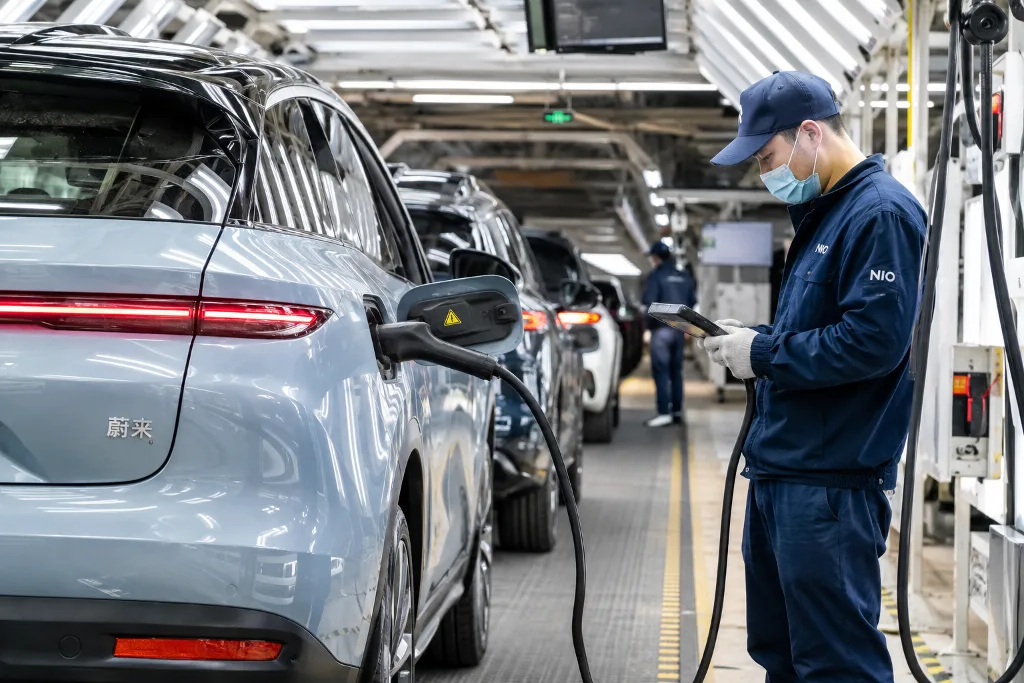
For years, the debate around Chinese electric cars has focused on price, range, charging speed and industrial scale. But China is now entering a new phase: technical standardisation and real-world safety. The recommended national standard GB/T 46991.1-2025, developed under the guidance of China’s Ministry of Industry and Information Technology and the Standardisation Administration of China, aims to make battery health information more reliable for drivers of light-duty passenger EVs.
The key concept is SOCE, or State of Available Energy. This measures the battery’s currently available energy compared with the available energy when the vehicle was new. It should not be confused with SOC, or State of Charge, which simply tells the driver how much energy remains during normal use. SOCE is more important for long-term ownership because it shows how much usable capacity the battery still retains after years of ageing, charging, discharging and thermal stress.
Under the standard, the relative difference between the SOCE value displayed by the vehicle and the physically measured value must not exceed 5%. That may sound like a narrow technical requirement, but it could have major consequences for used-car values, warranty disputes and consumer trust. If an EV claims to retain 85% battery health, buyers need to know that the number is not just an optimistic software estimate from the manufacturer.
The document also introduces the idea of “Virtual Mileage”, designed to account for energy consumed outside normal driving. An electric car can use energy while parked or while running auxiliary systems, climate control, electronics or connected functions. That energy use is not always clearly reflected in traditional mileage. China’s approach is to convert this non-driving energy consumption into an equivalent distance. In this case, the displayed value must stay within a 3% relative deviation from the measured result.
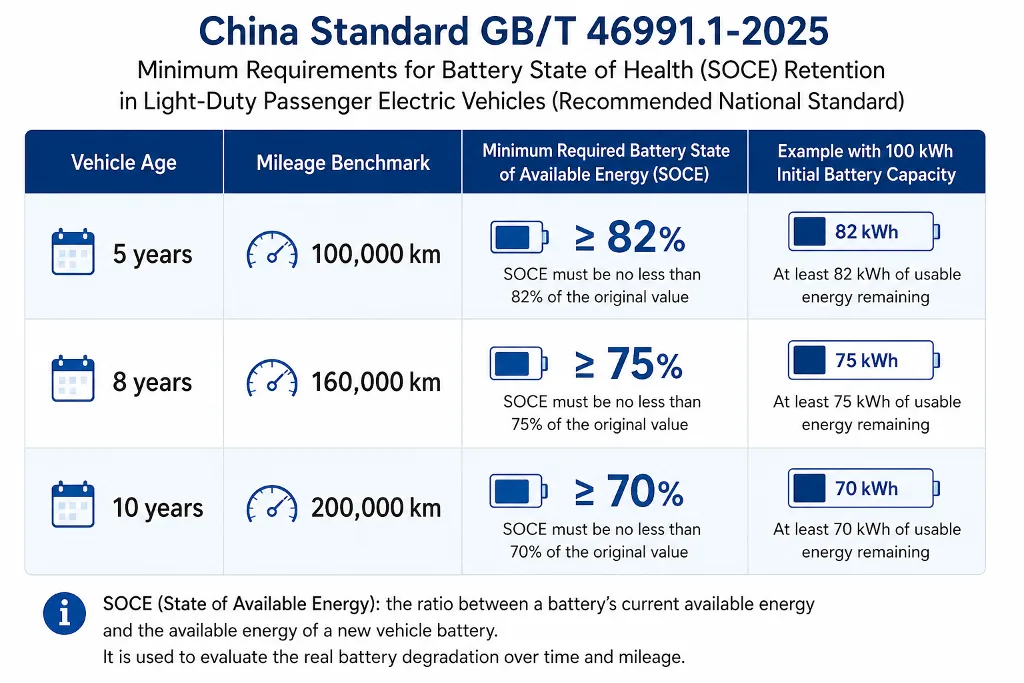
Battery durability benchmarks are another important part of the standard. The document sets reference levels for remaining available energy: at least 82% after five years and 100,000 km, 75% after eight years and 160,000 km, and 70% after ten years and 200,000 km. In practice, this creates a common basis for judging whether a battery has aged within reasonable limits. It could also help reduce disputes between carmakers, repairers, insurers and used-EV buyers.
It is important to note that GB/T 46991.1-2025 is not a mandatory safety regulation. It is a recommended national standard and, based on the disclosed information, does not establish public penalties, mandatory recalls or enforcement actions for cars that exceed the deviation limits. But it does create a shared technical language, and that can become highly influential if testing bodies, the used-car market and consumers begin to treat it as a reference point.
This measure arrives in a broader regulatory context. China has also tightened its EV battery safety framework through GB 38031-2025, a mandatory standard that raises requirements around thermal runaway, fire and explosion. The message is clear: it is no longer enough to sell electric cars with more range or faster charging. Manufacturers must also prove that batteries remain safe throughout their lifecycle, including after repeated fast-charging events or failure scenarios.
The same logic is now being applied to vehicle interiors and everyday usability. China has begun to correct some of the excesses of automotive digitalisation, especially the growing dependence on touchscreens for essential functions. The return of physical controls for key safety-related operations reflects a simple reality: a screen can lag, freeze, require too much visual attention or make an urgent action harder than it should be. In a car, not everything should depend on touchscreen menus.
There is also a growing focus on hidden or electric door handles, a feature widely adopted by modern EVs. Their aerodynamic and design benefits are clear, but in a crash or power-loss situation they can become a safety issue if there is no obvious and accessible mechanical release. China has decided to intervene in precisely this kind of feature, where innovation, styling and safety can easily come into conflict.
The conclusion is that China is beginning to lead the EV market from another angle. It first dominated battery supply chains, then production scale and domestic sales volume. Now it is using the size of its market to push standards on safety, transparency and ergonomics that other regions may eventually have to study closely. For Europe, the warning is obvious: Chinese competition will not only be about price. It will also be about technical regulation, consumer confidence and the speed with which manufacturers correct design mistakes that Western regulators are still debating too slowly.