
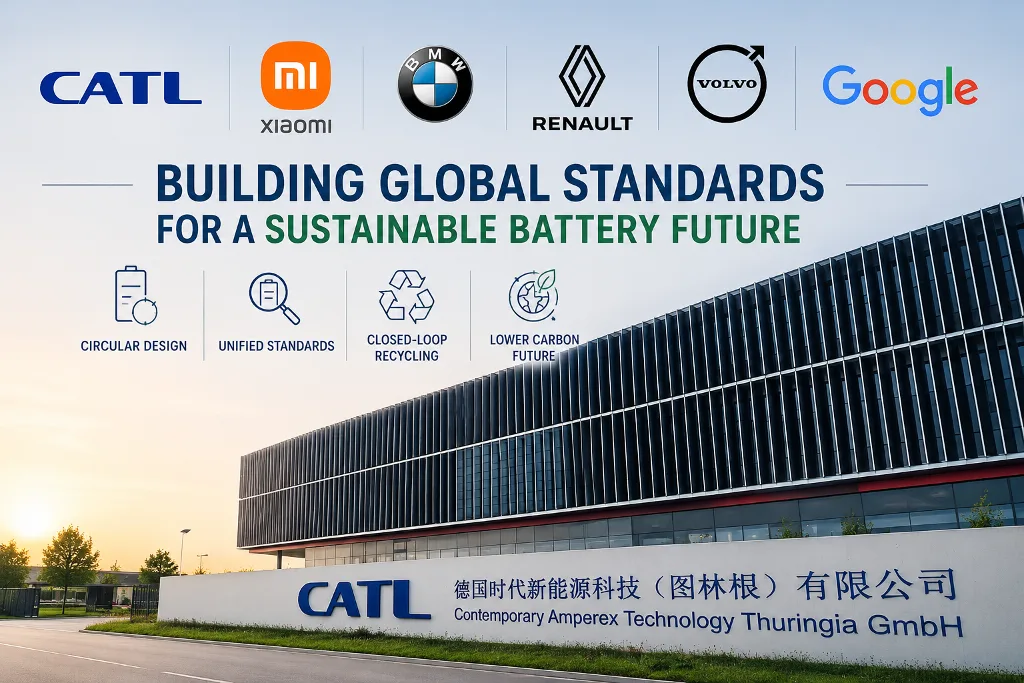
The alliance launched during London Climate Action Week is developing a future Battery Circular Design Guide, with full publication expected in 2027. The document is intended to establish common technical criteria for understanding a battery’s real condition, simplifying pack disassembly and improving cell reuse or remanufacturing. In practical terms, it means designing batteries around what happens after their life inside a vehicle, rather than focusing only on how quickly they can be assembled in a factory.
A battery can still retain a significant share of its original capacity even when it is no longer ideal for automotive use. The problem is that determining its real state of health is not always straightforward, because every manufacturer uses its own data, algorithms and operating parameters. The future guide aims to standardise how usage history, chemical degradation, residual capacity and economic value are assessed. That could help repair shops, insurers, leasing companies and fleet operators understand more accurately what a used battery is worth and whether it should be repaired, reused or recycled.
Standardisation could also influence how battery packs themselves are designed. Many current batteries are optimised to fit the greatest possible number of cells into a small space, reduce production costs and improve a vehicle’s structural stiffness. Those gains can make repair or end-of-life disassembly more difficult. The alliance is trying to find a balance: preserving safety, energy density and competitive cost while avoiding a situation where a localised fault forces an entire battery pack to be discarded even though much of its value remains intact.

The environmental dimension is equally important. A large share of a battery’s emissions footprint is linked to mining and refining materials such as lithium, nickel, cobalt, graphite and manganese. Recovering these materials and feeding them back into new cells can reduce the need for additional extraction and lower the carbon intensity of the supply chain. CATL says its recycling subsidiary Brunp processed 210,000 tonnes of battery waste in 2025 and recovered 99.6% of key minerals, although the real challenge will be making these processes profitable, scalable and verifiable beyond China.
The initiative arrives at a particularly important moment for Europe. EU regulation is already demanding greater traceability, carbon-footprint information and responsibility for batteries at the end of their life. A common guide could help manufacturers meet those obligations with less duplication, but it will not remove the differences between battery chemistries, pack architectures or safety standards. BMW, Renault, Volvo and Xiaomi will continue competing with different products, but they could do so with more compatible approaches to diagnosis, repair and recycling.
CATL is also trying to bring part of its Chinese industrial experience to Europe through projects such as the heavy-truck battery-swapping network it is developing with Octopus Energy. That initiative is separate from the circular design guide, but it follows the same underlying logic: a battery should not be treated only as a fixed component bought and discarded with the vehicle. It can be a repairable, swappable, reusable and recyclable asset. The real test will come in 2027, when the guide moves beyond a statement of intent and has to prove that it can cut costs, simplify repairs and help electric batteries retain value for longer.