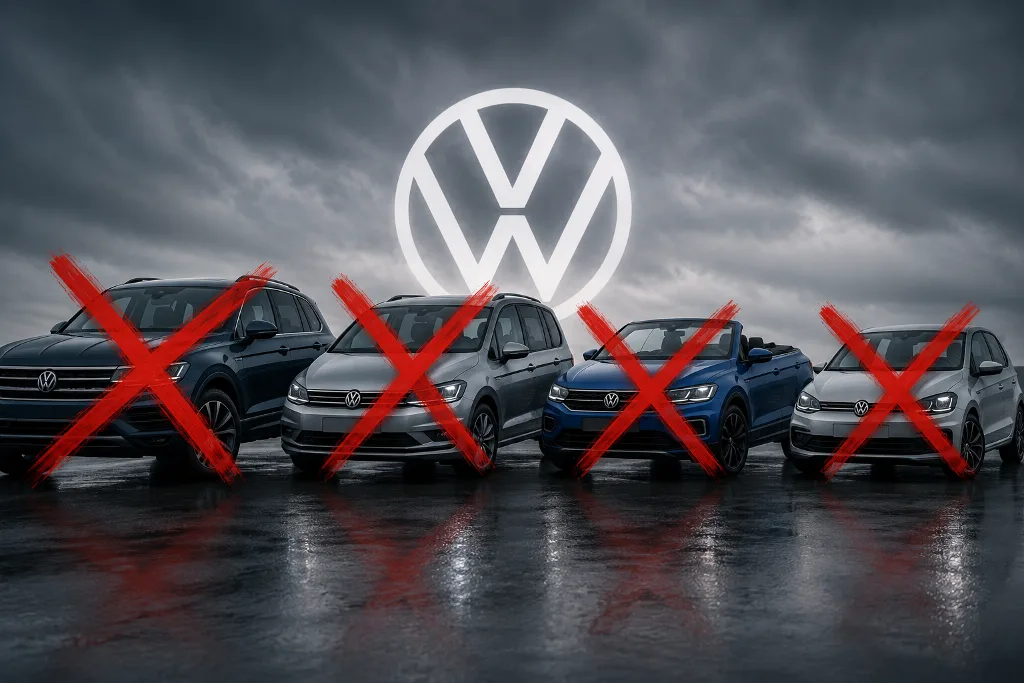
Volkswagen has announced one of the biggest product simplification plans in its recent history. The group, which includes Volkswagen, Audi, Porsche, Skoda, Seat, Cupra, Bentley and Lamborghini, plans to gradually streamline its global model range by up to 50%. The priority will be to keep vehicles competing in the most attractive and profitable market segments, while models with low volume, weak margins or internal overlap become much harder to justify.
The move will not only affect the number of models. Volkswagen also plans to cut offering complexity by up to 75%, including available equipment options and configuration combinations. For years, one of the group’s strengths was allowing customers to customise cars in great detail, even on mainstream models. That era now appears to be ending. The new strategy points toward simpler versions, fewer factory combinations, lower logistics costs and a sales structure closer to that used by some electric-only brands and Chinese manufacturers.
The decision reflects a deeper structural problem. Volkswagen remains one of the largest carmakers in the world, but its industrial footprint was built for a larger, more stable and less competitive market. Before the pandemic, the group had prepared capacity for around 12 million vehicles a year. It now wants to bring annual capacity down to roughly 9 million. That is a major reduction and shows how far the company is willing to go to align its size with actual demand.
Some models have already disappeared or are close to doing so. Within Volkswagen, models such as the Touareg and Touran have been removed from parts of the range, while the T-Roc Cabriolet is expected to end production in 2027. Audi has already moved on from the A1, Q2, TT, R8 and Q8 e-tron. Porsche has also ended combustion versions of the 718 Boxster and Cayman in Europe and is preparing to phase out the original Macan. Not all of these decisions are directly caused by the new plan, but they fit the same pattern: fewer niches, fewer overlaps and more focus on models with stronger returns.
The transition to electric vehicles makes the situation even more difficult. Volkswagen needs to invest heavily in EV platforms, software, batteries, driver-assistance systems and more flexible production. Maintaining a wide range of combustion, hybrid and electric models at the same time spreads resources too thin. The group appears to have concluded that it cannot compete with Tesla, BYD or Geely while carrying such a fragmented product structure.
The impact could be especially visible in Europe. European buyers have traditionally valued a broad choice of body styles, engines, trims and options, but that complexity is expensive. MPVs, convertibles, small saloons and low-volume niche models are likely to be the most exposed. Compact SUVs, high-volume electric cars and models with stronger margins should have a better chance of survival. The result could be a more rational and profitable Volkswagen range, but also a less diverse one.
Volkswagen has not confirmed additional plant closures or job cuts beyond those already announced, although German media have reported the possibility of deeper industrial adjustments. What is clear is that the group is entering a tougher phase of internal discipline. This is no longer only about launching more electric cars. It is about redesigning the entire group so it can compete on cost, speed and profitability.
The main risk is that this simplification comes too late or is executed poorly. If Volkswagen cuts weak models and reduces options without damaging customer appeal, it could gain efficiency and free up resources for its electric offensive. But if buyers see the new range as poorer, less distinctive or too expensive compared with Chinese rivals, the restructuring could deepen the problem. Volkswagen wants to become leaner and faster, but it will also have to prove that it can simplify without losing what made its brands strong in Europe for decades: variety, perceived quality and products closely adapted to local tastes.