
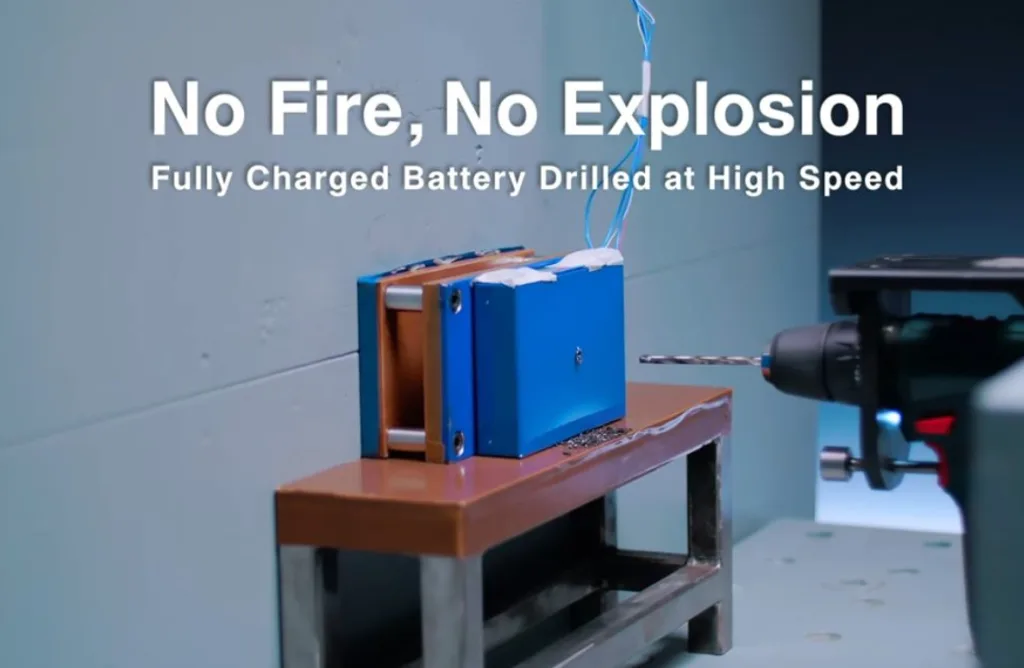
China is entering a new regulatory phase for new energy vehicles. From July 1, 2026, new mandatory national standards will tighten safety requirements for electric vehicles and traction batteries, including no-fire battery performance, physical high-voltage disconnection and tougher durability tests. The country is also moving toward mechanical door handles and physical controls, showing that leading the EV sector is not only about selling more cars, but also about setting higher safety standards.
China has dominated the global electric vehicle market for years in terms of volume, industrial speed and innovation, but now it is trying to lead in something less flashy and far more important: safety. On July 1, 2026, two new mandatory national standards come into force: GB18384-2025 for electric vehicle safety and GB38031-2025 for traction battery safety. The rules arrive as China’s new energy vehicle market continues to expand rapidly, with 1.554 million units produced and 1.496 million sold in May 2026 alone, while national NEV ownership had already reached 43.97 million vehicles by the end of 2025.
The most striking change concerns batteries. Until now, the standard required vehicles to provide a warning at least five minutes before a fire or explosion in the event of thermal runaway. The new approach goes much further: batteries must not catch fire or explode, while still providing warning signals and ensuring that smoke does not harm occupants. A new bottom-impact test is also being added to evaluate how well the battery pack is protected from underbody collisions, a particularly relevant scenario for electric vehicles, where the battery usually occupies much of the vehicle floor.
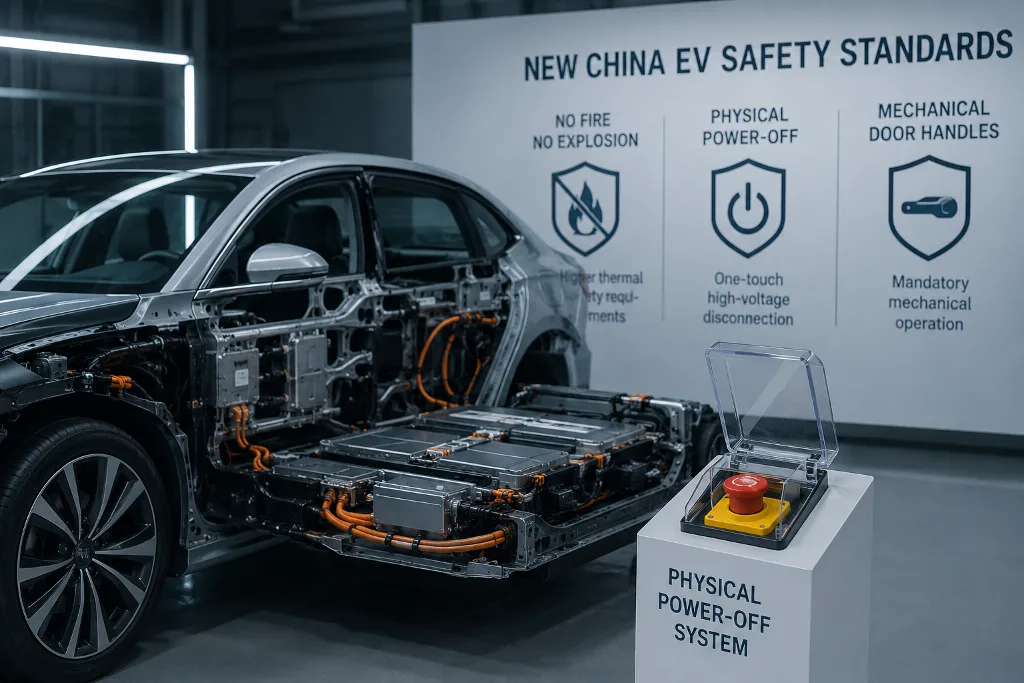
Another major change is the physical high-voltage power cut. China will require a one-touch physical disconnection mechanism designed to isolate the high-voltage circuit from the energy storage system without relying solely on software. It may sound like a small technical detail, but in a crash it can be critical. It helps emergency services, reduces electrical risks and prevents a safety function from being trapped behind a screen, an electronic control unit or a failed software system. Put simply, China seems to have reached a very sensible conclusion: when it comes to safety, a physical button still has a lot of charm.
The same philosophy can be seen in other rules pushing the industry back toward mechanical components and real controls. China has moved to ban hidden or electronic-only door handles, requiring mechanical opening functions both inside and outside new vehicles from 2027. The logic is obvious: a flush handle may improve aerodynamics and look great in a studio photo, but it is not very useful if an occupant or rescuer cannot open the door after a crash, power failure or fire. The same applies to interiors dominated by screens. The return of physical buttons for essential functions is not nostalgia; it is usability and safety.
The industrial impact could be significant. Manufacturers such as CATL and BYD already say their battery products are aligned with, or exceed, the new requirements, and the industry expects the rules to accelerate consolidation. Companies capable of meeting tougher standards will be strengthened, while brands competing only through low prices and lower-quality solutions may find it harder to survive. The rules could also help the used-car and insurance markets, since clearer battery safety, durability, thermal risk and power-disconnection standards should make vehicle valuation easier and reduce uncertainty for insurers.
The broader message matters for Europe and the rest of the world. China no longer wants to be only the country that builds the most electric cars, batteries and chargers; it wants to define what a safe electric car should be. That means an interesting mix of advanced technology and common sense: more resilient batteries, physical high-voltage power cuts, early thermal-event detection, door handles that can actually be opened and buttons that do not require drivers to dig through menus for basic functions. After years in which electric cars seemed to compete over how much could be hidden behind a screen, China is reminding the industry of something very basic: the future may be electric, but in an emergency it should still be touchable.