
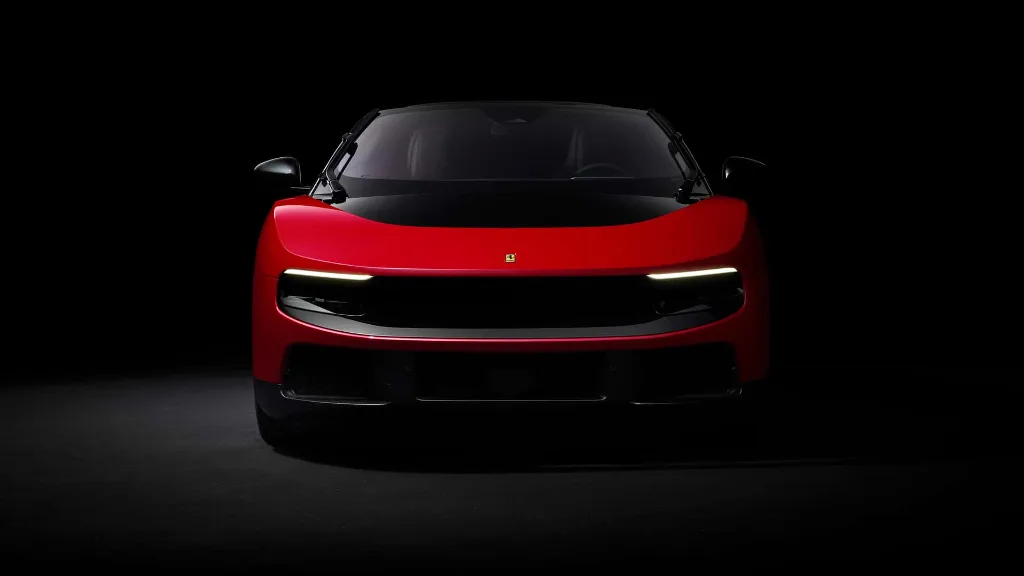
It is not a discreet first step into electric mobility. The Luce will become Ferrari’s second five-door model after the Purosangue, but also its first car with five real seats. At 5.03 metres long, almost 2 metres wide and 1.54 metres tall, it will also be the largest car ever produced by the Italian brand. Its price in continental Europe is expected to be around €550,000, placing it firmly in the most exclusive part of the market, even by Ferrari standards.
The technical side is one of the biggest headlines. The Ferrari Luce uses four electric motors, one for each wheel, with a combined output of around 1,050 hp. This layout allows the car to vary torque delivery instantly between individual wheels. The battery has a capacity of 122 kWh, operates at 800 V and is expected to provide an estimated range of around 840 km, still pending final homologation. For rapid charging, Ferrari claims peak rates of up to 350 kW and the ability to recover around 70 kWh in 20 minutes, an especially relevant figure for a high-performance electric car intended to cover long distances, not just win drag races outside luxury hotels.
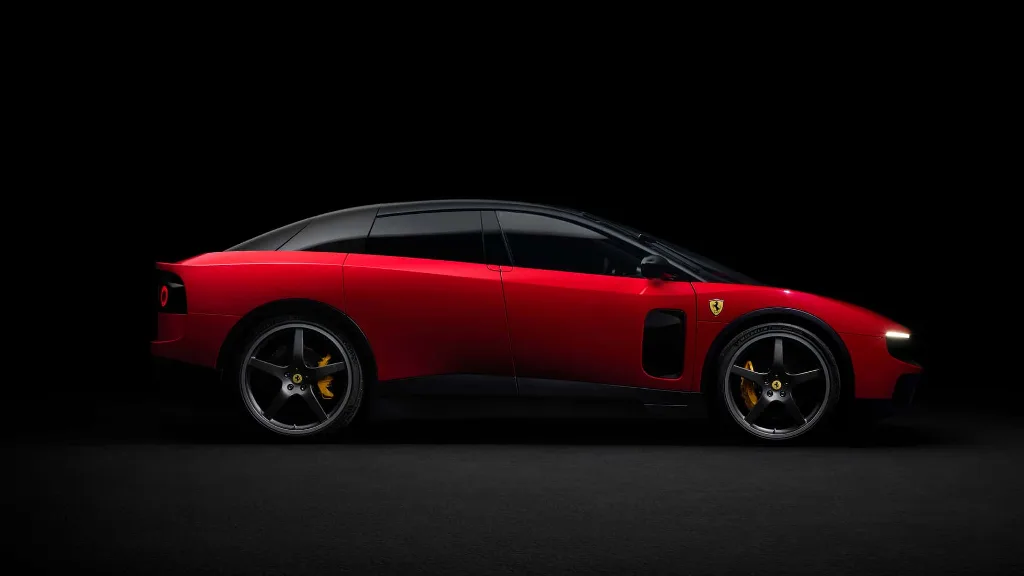
Performance is exactly where it needs to be for a car wearing the Ferrari badge. The Luce is expected to accelerate from 0 to 100 km/h in 2.5 seconds, reach 200 km/h in 6.8 seconds and continue to a top speed of roughly 309 km/h. Despite weighing 2,260 kg, Ferrari says the low centre of gravity, positioned 95 mm lower than in the Purosangue, active rear-wheel steering, 47:53 weight distribution and torque vectoring will allow the car to feel sharp and natural. Maranello clearly does not want the Luce to be just a very fast electric Ferrari in a straight line. It wants it to behave like a Ferrari, only without the combustion engine doing the shouting.
The design, however, is likely to be one of the most controversial parts of the car. Developed with LoveFrom, the studio founded by former Apple design chief Jony Ive and industrial designer Marc Newson, the Luce adopts a silhouette that is very unusual for Ferrari. It uses a cab-forward layout, rear-hinged back doors and a body shaped more around aerodynamic efficiency than maximum visual aggression. Ferrari says the Luce will have the lowest drag coefficient of any road-going Ferrari, with significantly more aerodynamic development than the Purosangue. In an electric car of this size and performance, every improvement in drag matters: it means more efficiency, more range and better stability at high speed. Still, for many Ferrari purists, this will probably be the kind of design that takes a few deep breaths, and maybe a strong espresso, to process.
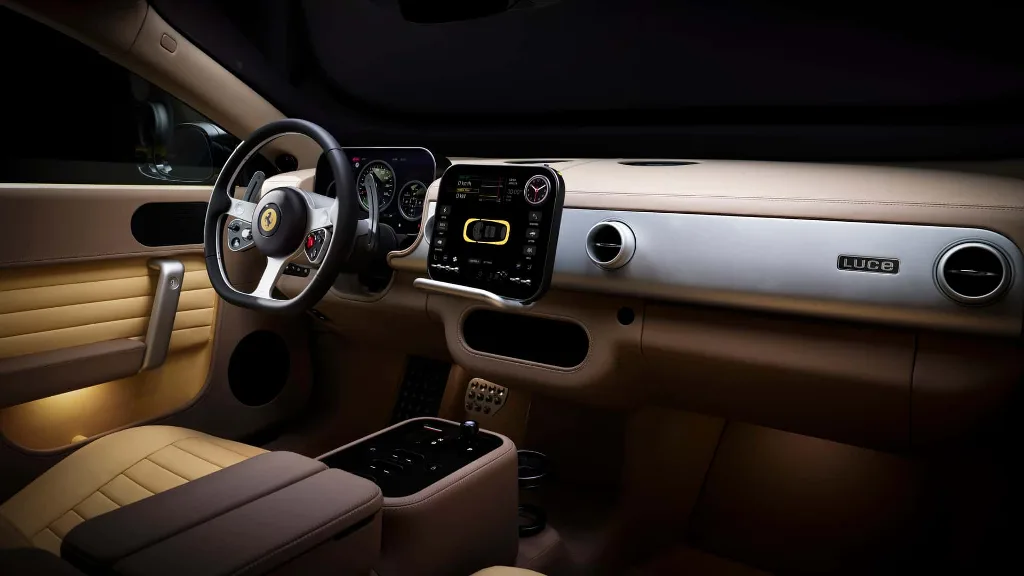
Inside, Ferrari tries to combine modern technology with a more physical driving experience, something increasingly rare in many current electric cars. The brand keeps real controls, high-quality touch surfaces and a compact steering wheel inspired by classic Ferrari models. Apple CarPlay and Android Auto will be available, but the general philosophy does not seem to be turning the cabin into one giant screen. Instead, Ferrari wants to preserve a direct interaction between driver and car. The steering wheel paddles also remain, although they will not simulate gear changes. One paddle will increase regenerative braking and reduce available power, while the other will progressively unlock more performance.
Ferrari will also amplify real sounds from the electric motors and gears inside the cabin, avoiding a fake nostalgic soundtrack designed to imitate a combustion engine. That decision is important. The Luce is not trying to pretend that electricity is petrol. It is trying to define what a Ferrari can feel like without cylinders, exhausts or mechanical drama coming from an engine bay. Whether traditionalists accept that is another question entirely, but Ferrari seems determined to create its own electric language rather than copy the past.
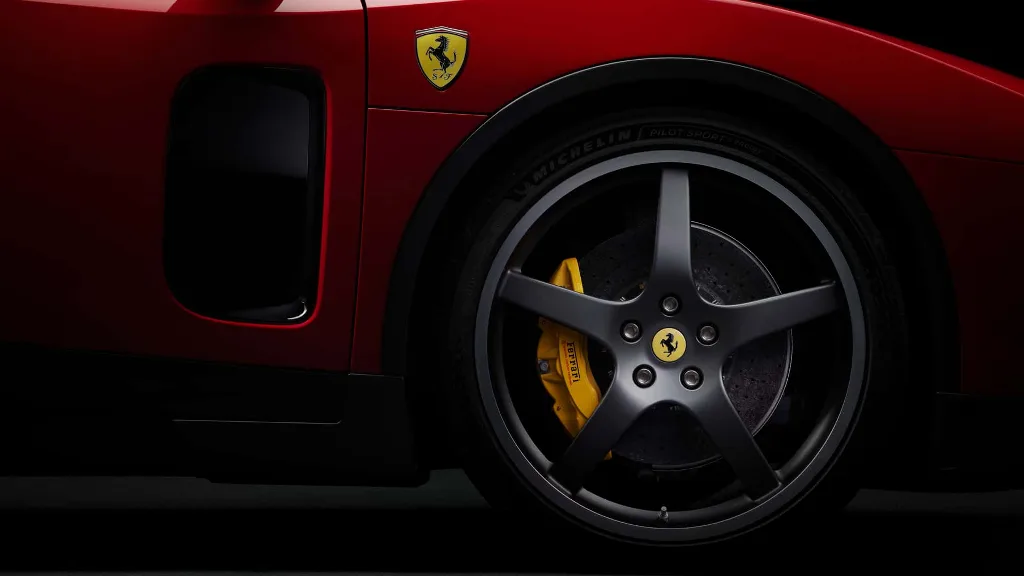
The Ferrari Luce will inevitably be one of those electric cars that almost nobody will own and very few people will ever drive. But it will also be one of the cars many enthusiasts will want to see, hear and experience, even if only once. Beyond its enormous figures and unreachable price, the Luce represents something very specific: Ferrari entering the electric era without apologies, with excess, spectacle and that familiar mixture of desire and impossibility that has always been part of the Maranello myth.