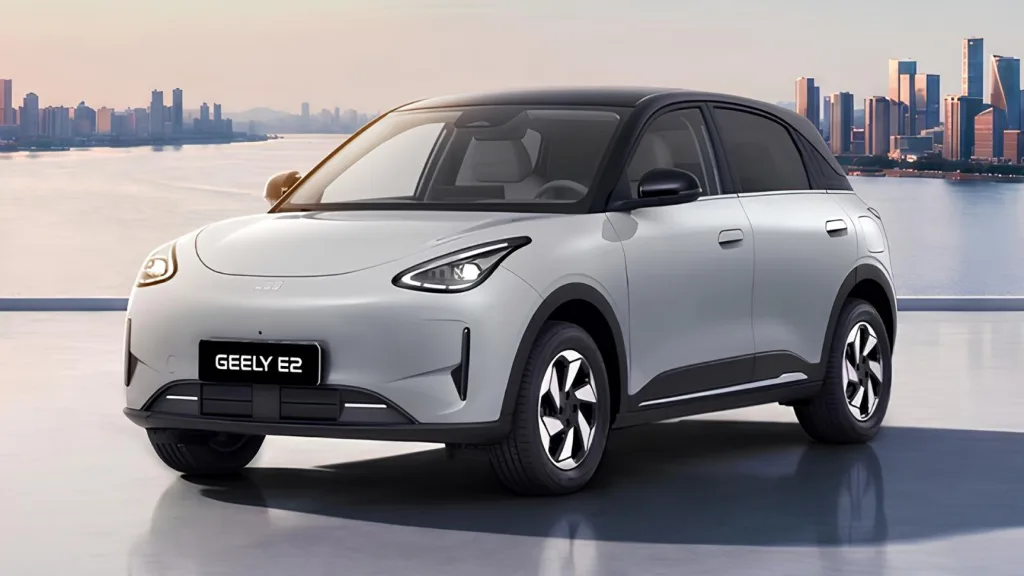
The Geely E2 will be a compact electric hatchback measuring 4.14 metres long, 1.81 metres wide and 1.58 metres tall, with a 2.65-metre wheelbase. On paper, those proportions place it somewhere between a traditional electric supermini and a small urban crossover. Its styling is deliberately simple and friendly, with a closed front end, rounded headlamps and wheels of up to 16 inches, but its purpose is not to compete on sportiness. It is designed to offer space, everyday usability and, potentially, a lower price than many European alternatives.
Practicality could become one of its strongest selling points. Geely lists a 375-litre boot and a 70-litre front storage compartment, an unusual combination in an electric car of this size. The cabin will also feature a 14.6-inch central screen, showing how Chinese manufacturers are increasingly bringing equipment once reserved for larger cars into entry-level models. In Europe, where cars such as the Renault 5 E-Tech, Citroën ë-C3, BYD Dolphin Surf and the future Volkswagen ID. Polo are all targeting price-sensitive buyers, that mix of size, technology and usable space could matter a great deal.
The known Xingyuan version uses an 85 kW rear-mounted electric motor, equivalent to 114 hp, paired with a 39.4 kWh battery. Geely points to up to 317 km of WLTP range and a 0-100 km/h time of 10.2 seconds, figures that make sense for a car aimed primarily at cities, suburban commuting and everyday driving. The company still has to confirm whether this exact configuration will be sold in the European Union, but the strategy appears clear: this is not a car designed to deliver the longest range on the market, but a balanced electric option for buyers who want to move into EV ownership without paying for a larger segment.
The key question will be commercial positioning. In China, the Xingyuan is sold at very low prices, but translating that affordability to Europe will depend on homologation, logistics, equipment levels, the dealer network and tariffs on Chinese-built electric cars. Geely will need to prove it can remain competitive without compromising on safety, warranty coverage or after-sales support. The E2 will not enter an empty market, but it will arrive at a moment when demand for smaller, simpler and more affordable EVs is becoming increasingly clear, exactly the territory where the Xingyuan has become one of Geely’s biggest successes.