
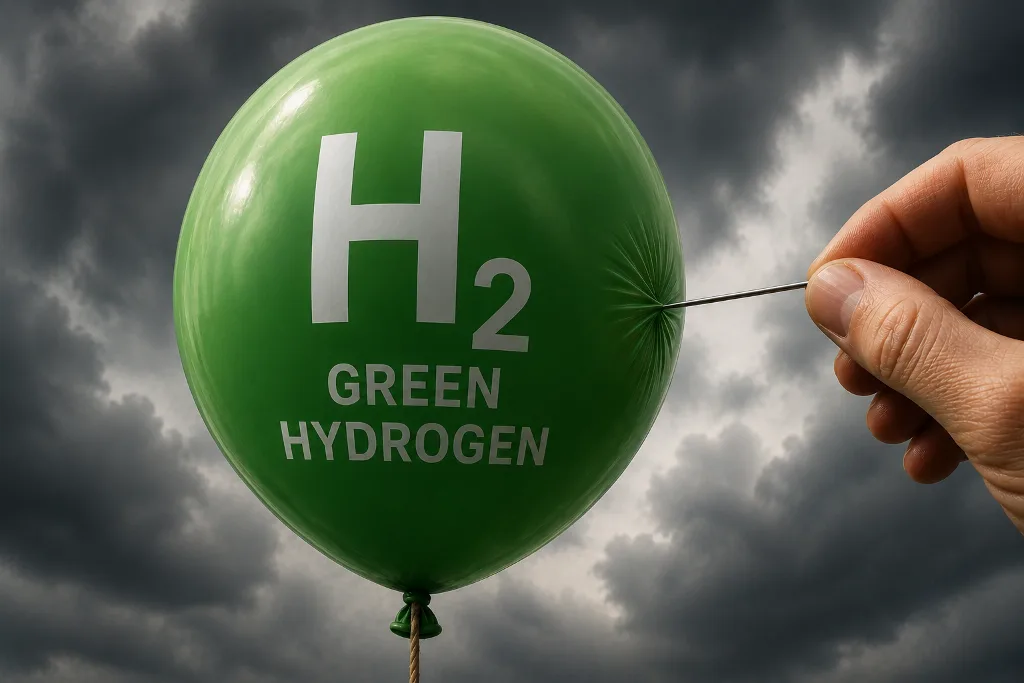
For years, green hydrogen was presented as one of the great solutions for decarbonising almost everything: industry, heavy transport, heating, power generation, energy storage and even urban mobility. Reality, however, is proving much more complicated. The latest example comes from the United Kingdom, where Clean Power Hydrogen, a company specialising in membrane-free electrolysers, has decided to abandon development of its flagship product after a serious failure during final testing.
The company was testing its 1 MW MFE220 electrolyser, a machine that uses electricity to split water into hydrogen and oxygen and is therefore a central component in green hydrogen production. The unit was approaching commercial deployment when it suffered severe damage during the final stage of factory acceptance testing. After inspecting the unit and reviewing the available data, CPH2 concluded that the electrolyser cannot be repaired and that a substantial redesign would be required to ensure its mixed-gas system can operate safely under all conditions. The problem is that the company admits it currently lacks the financial, technical and engineering resources needed to carry out that redesign.
As a result, CPH2’s board has decided not to restart the final testing phase of the MFE220 and, at least for now, to step away from manufacturing its own electrolyser. Instead, the company will explore commercial alternatives based on licensing, strategic agreements and the use of its intellectual property. CPH2 still has a portfolio of patents, designs, schematics and more than a decade of accumulated technical know-how, but the blow is clear: its most important product will not reach the market as originally planned.
The CPH2 case does not prove on its own that green hydrogen has no future, but it does fit into a broader trend. The sector is moving from the era of big announcements into a much more demanding phase, where future capacity claims are no longer enough. Projects now have to prove that they work, that they are safe, that they can scale and that there are customers willing to pay for them. That is where hydrogen is finding far more difficulties than many early narratives suggested.
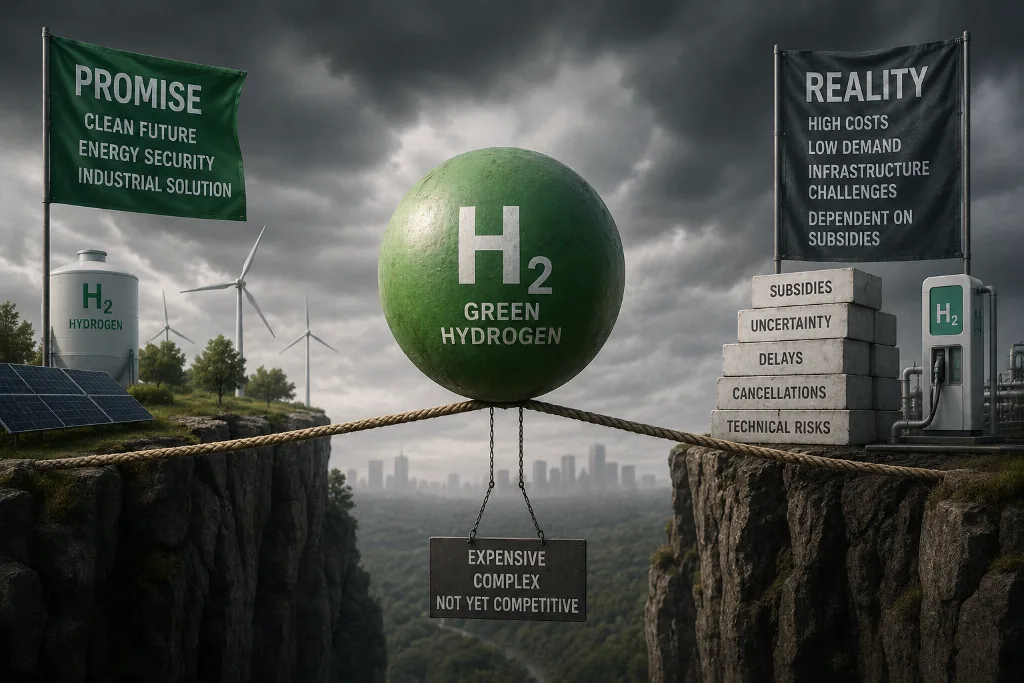
The underlying problem is that green hydrogen remains expensive to produce, complex to transport, difficult to store and dependent on dedicated infrastructure. In many applications, it is not only competing against fossil fuels, but also against more direct, more efficient and increasingly cheaper electric alternatives. That comparison is especially tough in mobility, where battery-electric vehicles already benefit from a mature industrial base, factories, customers, charging networks and growing economies of scale.
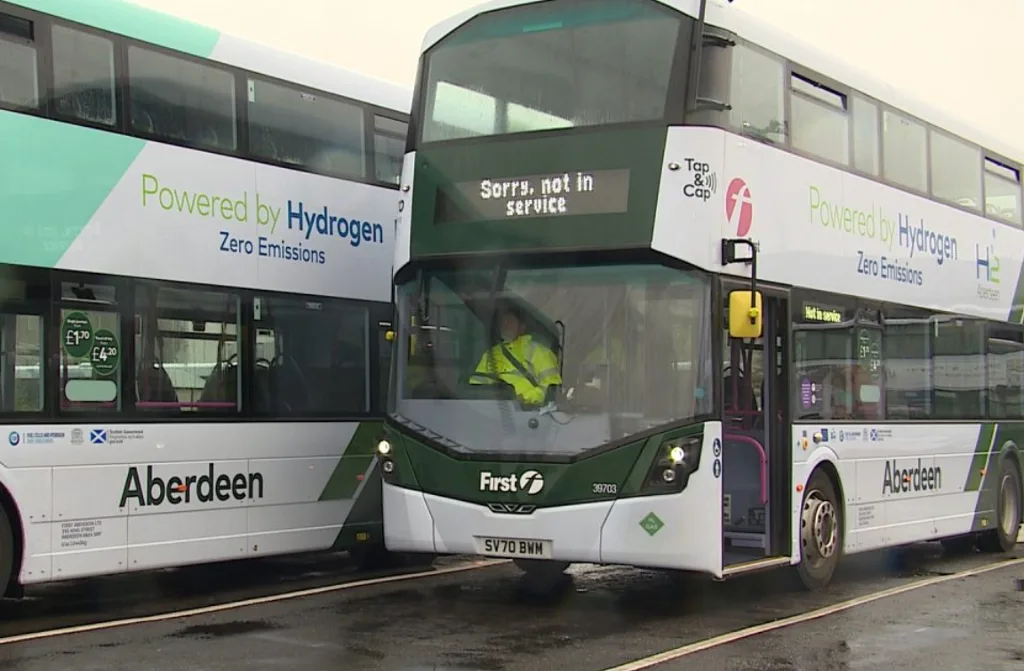
A clear example can be found in Aberdeen, Scotland, a city that for years was one of Europe’s showcases for hydrogen public transport. It operated a fleet of 25 hydrogen double-decker buses, once presented as an international reference point. However, the project was eventually abandoned and the city council decided to pivot towards battery-electric buses. The fleet cost close to £13.9 million and remained unused for a period due to problems linked to hydrogen refuelling infrastructure.
That case sums up one of hydrogen’s key weaknesses in mobility: buying the vehicles is not enough. A complete chain of production, compression, storage, distribution and refuelling also has to be maintained. Battery-electric buses, by contrast, can rely on a much more widespread electricity infrastructure and on a technology whose costs are already falling through scale. Hydrogen can offer fast refuelling and good range, but if the total system cost becomes too high, that advantage quickly loses much of its strength.
The same problem can also be seen in passenger cars, where Toyota has spent years trying to defend hydrogen fuel-cell technology with the Mirai as its technological showcase. On paper, the concept has appeal: fast refuelling, good range and zero local emissions. But the commercial reality has been very different. Even in markets where Toyota has tried to keep the technology alive, Mirai sales have become increasingly marginal, with just 255 units sold in the United States in 2025. High hydrogen prices, a lack of refuelling stations and a less convenient user experience than a battery-electric car have all weighed heavily. If a manufacturer with Toyota’s industrial strength, reputation and technological patience has not managed to turn the hydrogen car into a remotely mainstream option, it is hard to argue that this solution will dominate passenger transport through technical superiority alone.
The pressure is also visible in much larger industrial projects. In recent months, hydrogen plans in several markets have faced cancellations, delays or downward revisions. The International Energy Agency has warned that expectations for low-emissions hydrogen production by 2030 have been reduced for the first time, precisely because of cancellations and delays. Reuters has also documented projects being postponed or abandoned due to high costs, weak demand and regulatory uncertainty.
Germany is perhaps the most relevant example of how hydrogen risks becoming an extremely expensive bet if real demand does not materialise. An analysis by the Institute for Energy Economics and Financial Analysis warns that the country could overbuild its hydrogen network and leave taxpayers exposed to tens of billions of euros in costs. According to its estimates, if demand ends up in a limited scenario, German citizens could be liable for at least €34.7 billion in pipeline costs by 2055.
The central risk is that Germany is financing its future hydrogen network on the assumption that demand will grow fast enough for users to repay the infrastructure costs over time. But if that demand fails to appear, the cost will not disappear: it will fall on public finances. The difference between a rapid rollout and a limited rollout could amount to €45 billion in additional public funding, around €1,000 per German taxpayer.
This is key to understanding the debate. Hydrogen is not, in many cases, a technology that is naturally imposing itself because it is cheaper, simpler or clearly superior to the alternatives. In many applications, it needs optimistic demand forecasts, favourable regulation and continued public funding to sustain deployment. That does not mean hydrogen cannot play an important role, but it does mean the early enthusiasm needs to be tempered with a more rigorous analysis of where it actually makes sense and where it does not.
Germany’s pivot towards blue hydrogen adds another contradiction. The Hydrogen Acceleration Act approved in 2026 treats blue hydrogen, produced from natural gas with carbon capture and storage, as being in the “overriding public interest”. This marks a shift away from the original idea of fully green, renewable hydrogen and could reinforce gas dependence, require new CO₂ infrastructure and prolong the life of liquefied natural gas terminals. In other words, part of a strategy initially presented as a path towards energy independence risks keeping the system tied to international gas markets.
Spain offers a similar warning, although on a smaller scale. Repsol and its partner RIC Energy reportedly decided not to move ahead with the Hydric Power green hydrogen project in Puertollano, which was planned on the site of the former La Sevillana coal-fired power plant. The project aimed to build up to 200 MW of renewable hydrogen capacity and supply Repsol’s nearby petrochemical complex, but it was ultimately considered technically and economically unfeasible. Local reports described the cancellation as the collapse of a €110 million investment that was expected to create around 70 direct jobs. For a country that wants to become a European hub for green hydrogen, Puertollano is a useful reminder that political ambition and industrial reality do not always move at the same speed.
The case is especially relevant because Puertollano was not an abstract hydrogen concept in the middle of nowhere. It was linked to an existing industrial area, had a potential nearby consumer and fitted neatly into Spain’s official green hydrogen narrative. Even so, the numbers did not work. That makes the message harder to ignore: if projects with industrial demand close by can still fail on technical and economic grounds, the wider hydrogen rollout needs to be judged with far more caution than the early optimistic narrative suggested.
For Europe, the lesson should be one of caution. Hydrogen can still have a useful role in areas where direct electrification is difficult, such as certain chemical processes, fertilisers, steelmaking or high-temperature industrial applications, but that should not be confused with an unlimited bet on a technology that still needs large amounts of public money to sustain much of its deployment. In cars, vans, urban buses and much of light transport, batteries have already built a major industrial advantage: they are on the market, improving every year and supported by an expanding charging infrastructure. The abandonment of CPH2’s MFE220, Aberdeen’s hydrogen buses and the risk of overbuilding national networks such as Germany’s all point in the same direction: hydrogen will have its niches, but it is far from winning through technological or economic superiority alone. The optimistic headlines are giving way to a more selective reality in which projects will have to prove they are safe, scalable, financeable and capable of surviving beyond subsidies.
Sources: Renewables Now, CleanTechnica, IEEFA.