
Europe’s stationary battery market is entering a new phase. After adding 36 GWh of storage capacity in 2025, up 48% from the previous year, annual installations could exceed 50 GWh in 2026 and reach 138 GWh per year by 2030. The key shift will come from larger utility-scale projects designed to store renewable electricity when supply is abundant and release it when demand rises or solar and wind output falls.
The most important change is that storage will no longer depend mainly on small residential or commercial batteries. Grid-scale systems are projected to account for 75% of Europe’s annual storage market by 2030, up from 53% last year. This reflects an increasingly obvious need: as more solar and wind farms are added, Europe needs systems capable of absorbing surplus generation and reducing volatility in electricity markets.
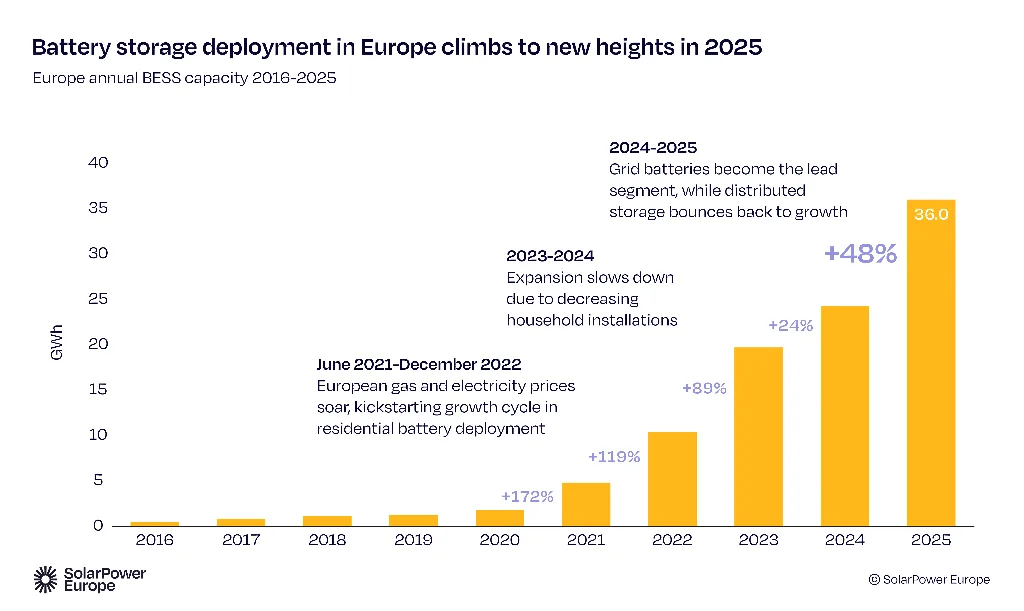
SolarPower Europe estimates that total battery storage capacity in the EU will rise from 77 GWh in 2025 to around 470 GWh by 2030. That would be a major expansion, but still below the roughly 600 GWh the association considers necessary to align with Europe’s energy security, competitiveness and climate targets. The message is straightforward: storage is growing rapidly, but electrification and renewable deployment are moving even faster.
Germany, the United Kingdom and Italy recorded the highest installation volumes in 2025, while Ukraine and Bulgaria stood out for their rapid growth and entered Europe’s five largest storage markets. Ukraine’s presence is particularly notable because battery storage is becoming not only a tool for renewable integration, but also a source of energy resilience and response capacity for vulnerable or stressed electricity systems.
The broader point is that batteries are no longer an optional add-on to the energy transition. They are the infrastructure that allows solar and wind power to be used when it is actually needed. Without enough storage, part of renewable generation will have to be curtailed, electricity prices will remain more volatile and Europe will depend for longer on gas-fired plants to cover peak demand. The real challenge of this decade will therefore not only be building more renewable capacity, but also adding the grids, interconnections and battery systems needed to turn cheap but variable energy into reliable electricity at any time of day.
Source: solarpowereurope.org