
The Tesla Semi has always been one of Tesla’s most striking electric vehicles. It is not a passenger car, an SUV, or even a pick-up like the Cybertruck, but a heavy-duty electric truck designed to move freight with a gross combined weight of up to 82,000 pounds, around 37,200 kg, while still being capable of covering long distances.
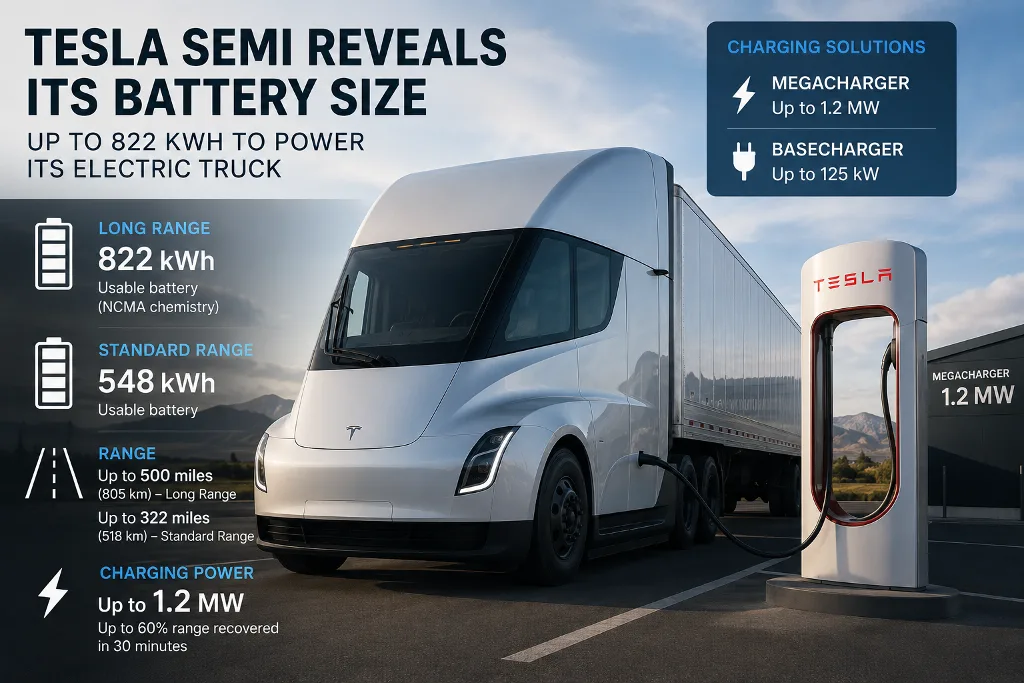
Until now, one of the biggest unknowns was the real size of its battery packs. Tesla had talked about range, efficiency and fast-charging capability, but had not openly published the usable capacity of the Semi’s batteries. That information has now appeared in an official document from the California Air Resources Board, known as CARB, the Californian agency responsible for emissions regulation and zero-emission powertrain certification. The document certifies the Tesla Semi electric powertrain family for the 2026 model year, revealing an 822 kWh battery for the Long Range version.
The Tesla Semi Long Range is the most ambitious version of the truck. According to the CARB document, it uses an 822 kWh usable battery pack with NCMA lithium-ion chemistry, based on nickel, cobalt, manganese and aluminium.
Tesla claims an approximate energy consumption of 1.7 kWh per mile for the Semi, together with a driving range of up to 500 miles, around 805 kilometres, on a single charge.
The Standard Range version also comes with a huge battery. The same document confirms the existence of a Tesla Semi Standard Range variant with a usable battery capacity of 548 kWh.
Using Tesla’s stated average consumption of 1.7 kWh per mile, the theoretical range of this version would be around 322 miles, or roughly 518 kilometres.
This version could make a lot of sense for regional routes, heavy-duty distribution between logistics centres, or repetitive journeys where daily mileage is predictable and charging infrastructure is available at the starting point or destination.
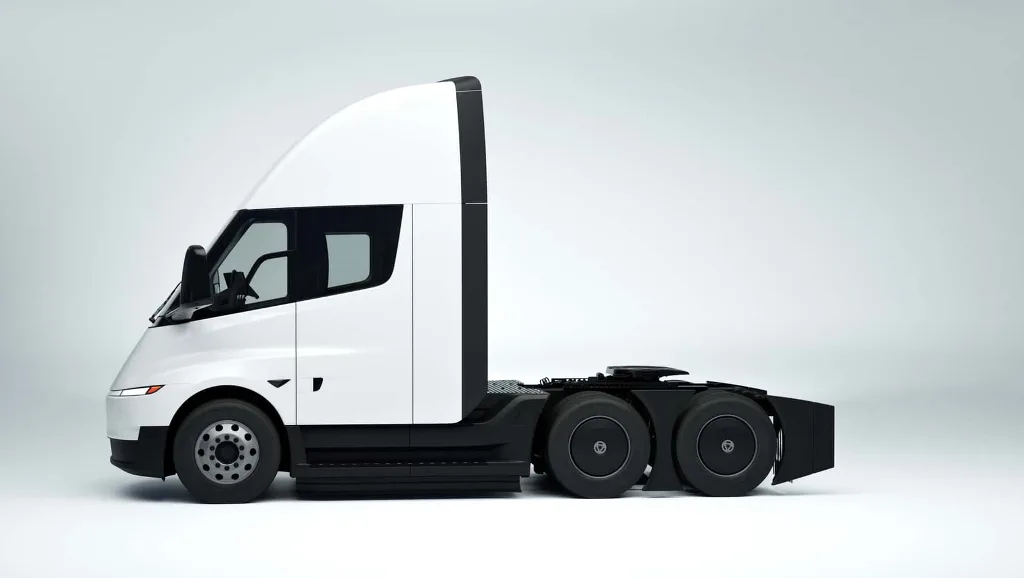
Another of the most impressive aspects of the Tesla Semi is its charging system. Tesla says the truck can recover up to 60% of its range in 30 minutes using dedicated Semi chargers.
Maximum charging power reaches 1.2 megawatts, or 1,200 kW. That figure is difficult to compare directly with the fast charging of a conventional electric car, because this is an entirely different scale.
Tesla has also presented solutions such as the Megacharger, designed specifically to charge the Semi at very high power, as well as a simpler system called Basecharger, offering up to 125 kW for situations where ultra-fast charging is not required or where the electrical installation cannot support such high power.
With these figures, the Semi starts to move beyond estimates and becomes a much more concrete proposition. Its battery capacity matches the announced range, its 1.2 MW charging system points to a new generation of infrastructure for heavy-duty transport, and its move towards production could open a very interesting chapter for electric trucks.