
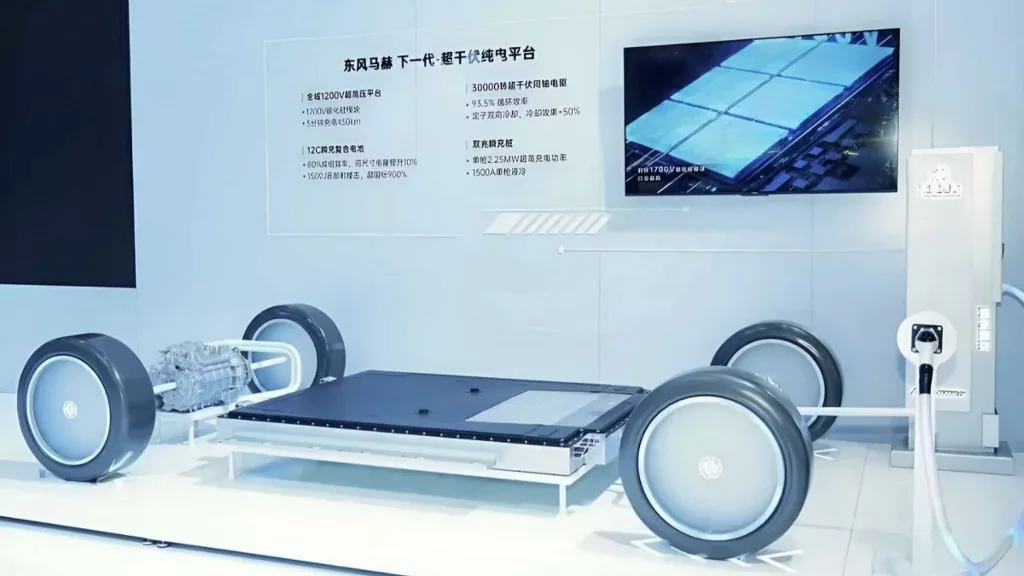
Solid-state batteries have been described for years as the next major leap for electric vehicles, but they have often felt permanently five years away. Dongfeng’s latest roadmap changes that perception. The Chinese automaker is preparing mass production and vehicle installation for the second half of 2026, bringing the technology much closer to real-world deployment than many previous industry promises suggested.
The central claim is a battery with an energy density of 350 Wh/kg, enough to enable new energy vehicles to exceed 1,000 km of driving range. Beyond range, solid-state technology also promises a major safety advantage by replacing the liquid electrolyte used in conventional lithium-ion batteries with a solid electrolyte. Dongfeng says its cells have passed demanding safety tests, including extreme deformation, heat exposure at 170 ºC without smoke or fire, and cold-weather testing at temperatures as low as -30 ºC.
Dongfeng has chosen an oxide-polymer composite technical route, widely seen as one of the more practical paths toward faster industrial adoption because it can make use of mature supply chains and existing production equipment. The company also claims full self-reliance in core technologies, covering electrodes, solid electrolytes and complete battery pack integration. Its development base now combines laboratory testing, trial manufacturing and pilot production lines.
The wider context is just as important. Dongfeng is not alone, with companies such as GAC, CATL and FAW also pushing solid-state battery programmes toward production between 2026 and 2027. What is changing is the tone of the industry. Solid-state batteries are no longer only a future breakthrough shown in laboratories or investor presentations. If Dongfeng meets its timeline, electric cars could soon enter a new phase with longer range, lower weight, improved safety and one of the biggest psychological barriers finally removed: the idea that solid-state batteries are always close, but never actually arrive.