
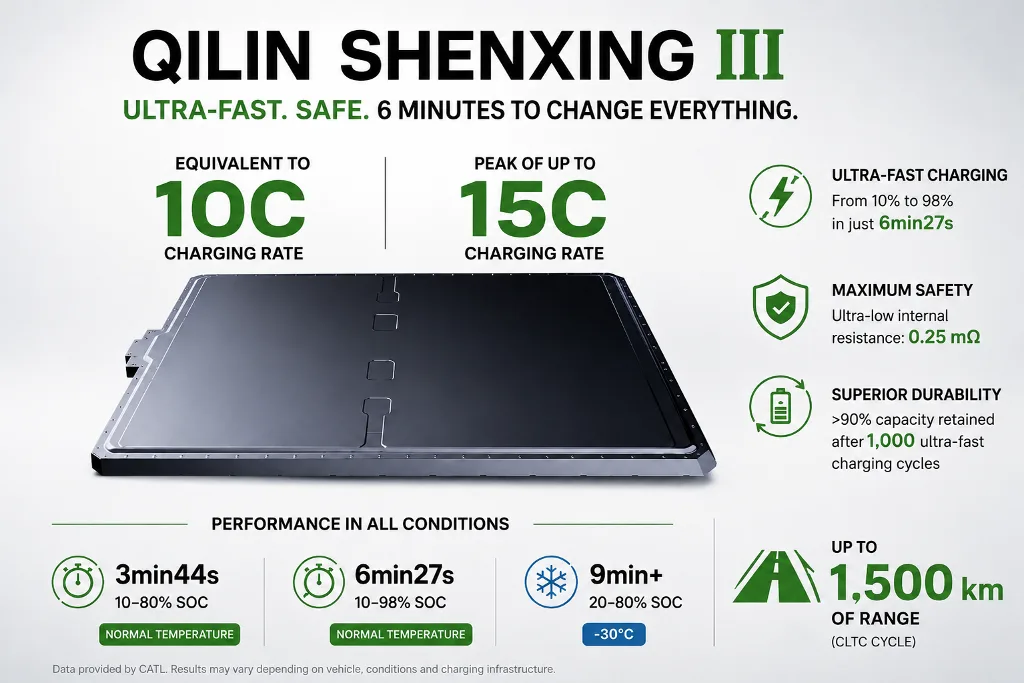
CATL has once again raised the bar in the electric car battery race with the third generation of its Qilin Shenxing. The Chinese company claims this new LFP battery can charge from 10% to 80% in 3 minutes and 44 seconds, and reach 98% in 6 minutes and 27 seconds. If these figures are confirmed in production vehicles, electric charging times would move much closer to the kind of stop drivers are used to when refuelling.
The key lies in reducing the battery’s internal resistance, one of the main obstacles to ultra-fast charging. CATL refers to an average resistance of 0.25 milliohms, which would allow a large amount of power to be delivered without generating as much heat. Put simply, it is not enough to have increasingly powerful chargers: the battery itself also has to be able to absorb that energy without degrading too quickly or compromising safety.
The new Shenxing III combines improvements in the LFP cathode, the graphite anode and the thermal management of the cells. It also incorporates a pulse heating system designed to maintain good charging speeds even in extreme cold. According to CATL, at -30 ºC it can charge from 20% to 80% in just over nine minutes, a particularly interesting figure for markets where low temperatures have a major impact on electric vehicles.
Durability is another important point. CATL says the battery retains more than 90% of its capacity after 1,000 ultra-fast charging cycles, a relevant claim because charging quickly once is not enough: the real challenge is doing it for years without putting excessive stress on the battery. Even so, these figures will need to be proven in real-world use, across different cars, climates and charging habits.
The announcement comes in the middle of a major technology push from Chinese manufacturers, with BYD also moving aggressively with its Blade Battery 2.0 and Flash Charging system. The battle is no longer just about offering more range, but about reducing charging stops to the bare minimum.
If CATL manages to bring this technology to high-volume models, six-minute charging could become one of the strongest arguments for convincing drivers who still see charging time as one of the main weaknesses of electric cars.