
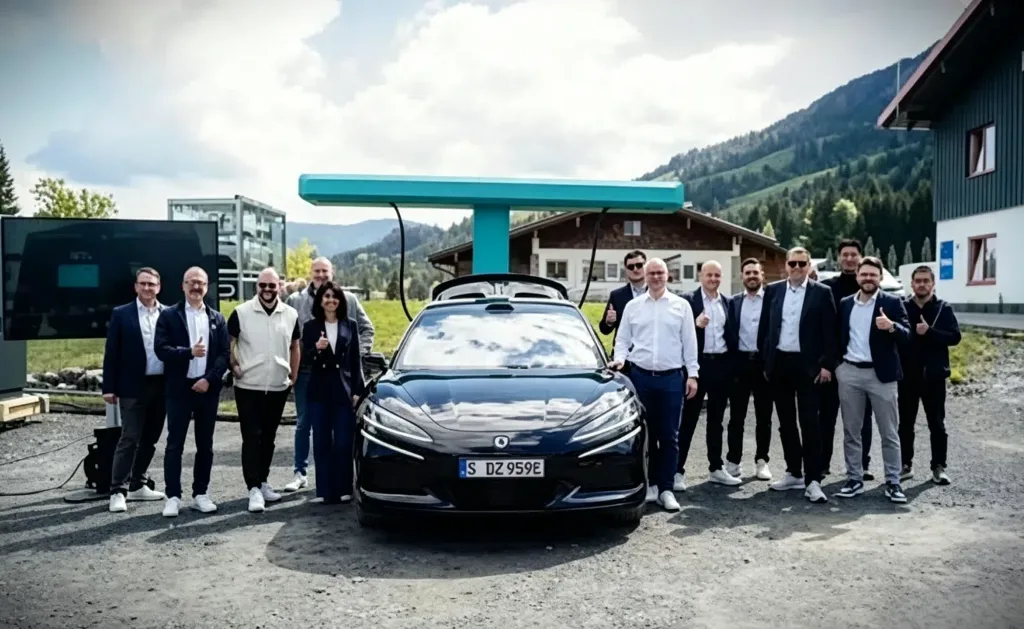
BYD is bringing one of its most ambitious electric vehicle technologies to Europe: ultra-high-power flash charging. The Chinese carmaker has opened its first commercial station in Germany using its second-generation charging hardware, an architecture capable of delivering up to 1,500 kW. This is not simply a case of installing more powerful chargers. It is about building an ecosystem designed around BYD’s next generation of batteries and vehicles capable of accepting extremely high charging rates.
The system was already shown in Europe during a presentation in Paris, alongside the Blade Battery 2.0 and Flash Charging 2.0. According to BYD, compatible vehicles can charge from 10% to 70% in around five minutes and from 10% to 97% in nine minutes. Those figures are far beyond what most current fast chargers can offer and place BYD’s peak charging architecture well above Tesla’s V3 Superchargers and current V4 units on paper.
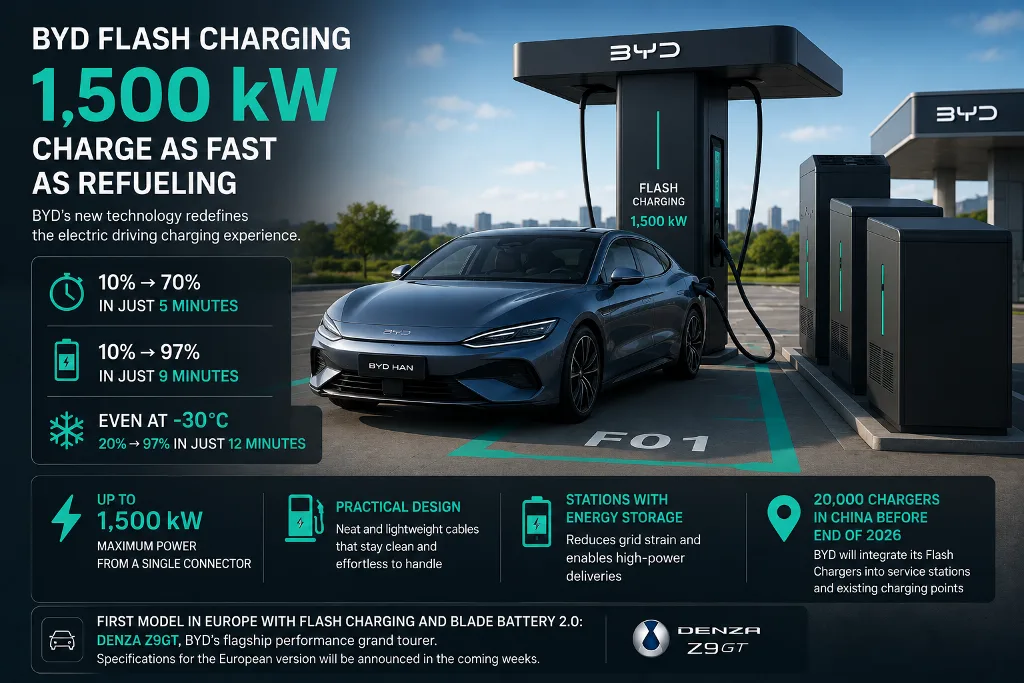
The key point, however, is that the charger alone is not enough. For a 1,500 kW station to make sense, the car must be able to accept that level of power safely and consistently. That requires battery cells, cooling systems and power electronics designed for extreme charging without compromising durability. This is where BYD wants to use its vertical integration as an advantage: it develops its own batteries, electric powertrains, vehicles and now a dedicated charging network.
The European plan is ambitious. BYD aims to deploy 3,000 flash-charging stations across Europe by the end of 2026, as part of a wider target of 6,000 stations outside China. The strategy follows its rapid domestic rollout, with industry reports pointing to more than 6,100 flash-charging stations already built across over 300 Chinese cities. BYD has even expanded the network into high-altitude areas, including a site near Mount Everest, and has signed agreements with Sinopec to accelerate infrastructure deployment through China’s largest fuel-station network.
For Europe, this is an important shift. Until now, much of the conversation around BYD has focused on vehicle prices, LFP batteries and manufacturing scale. With this rollout, the company is also moving into infrastructure, one of the areas that helped Tesla build such a strong position in the electric vehicle market. A fast, reliable and proprietary charging network could become a major selling point, especially if it is linked to premium models able to take full advantage of it.
That is where Denza comes in. BYD’s premium brand is expanding in Europe at the same time as the charging network. Denza has opened its first dedicated German showroom in Hamburg and plans around 40 German stores by the end of 2026. It also aims to launch eight models across Europe by the end of 2027. Flash charging could become a key differentiator for these vehicles, particularly if BYD can deliver charging times that come close to the convenience of conventional refuelling.
For the wider European market, the German launch is a signal of what may come next. If BYD can expand this network across major corridors and urban areas, it could strengthen its position significantly, especially among drivers who still worry about charging times on long journeys. Ultra-fast charging remains one of the most important factors in how many people perceive electric cars, and a well-functioning 1,500 kW network could change that experience considerably.
The arrival of BYD’s 1,500 kW stations in Europe shows that the next stage of the EV race will not be fought only on price, range or battery chemistry. Infrastructure, charging speed and control of the full user experience will matter just as much. BYD no longer wants to be seen only as a maker of affordable or competitive electric cars. It wants to build a complete ecosystem around them. With 1,500 kW flash charging, the message is clear: Europe has become the next major battleground.