
BYD wants to take another step forward in the race for assisted driving. The Chinese company has announced full damage coverage for its Urban Navigate on Autopilot function, known as Urban NOA, within its God’s Eye system. This guarantee will apply in China to both new buyers and current owners who upgrade to God’s Eye 5.0. According to the brand, if an accident involving legal liability occurs while the user is using Urban NOA in compliance with traffic regulations, BYD will directly cover the financial losses resulting from the incident.
The measure follows a similar coverage scheme applied to intelligent parking, making BYD, according to the company itself, the first manufacturer in the world to offer damage protection for two advanced driver assistance functions: intelligent parking and assisted urban navigation. Beyond the commercial impact, the message is clear: BYD wants to show users that it trusts its systems enough to assume part of the financial risk associated with their use.
It is also a way to stand out from Tesla, which has made Autopilot and FSD one of its main technology arguments, but without offering equivalent damage coverage linked to the use of these functions. BYD is trying to send a different message: it does not only want to sell assisted driving, it also wants to build trust around it.
BYD’s confidence is based on three pillars. The first is scale: the brand says it has more than 3.15 million vehicles equipped with intelligent driving assistance, the largest fleet among Chinese manufacturers. The second is the huge amount of data generated by God’s Eye, with more than 200 million kilometres recorded every day, allowing the company to continuously feed and improve its algorithms. The third is an R&D team made up of 5,000 engineers dedicated to intelligent driving.
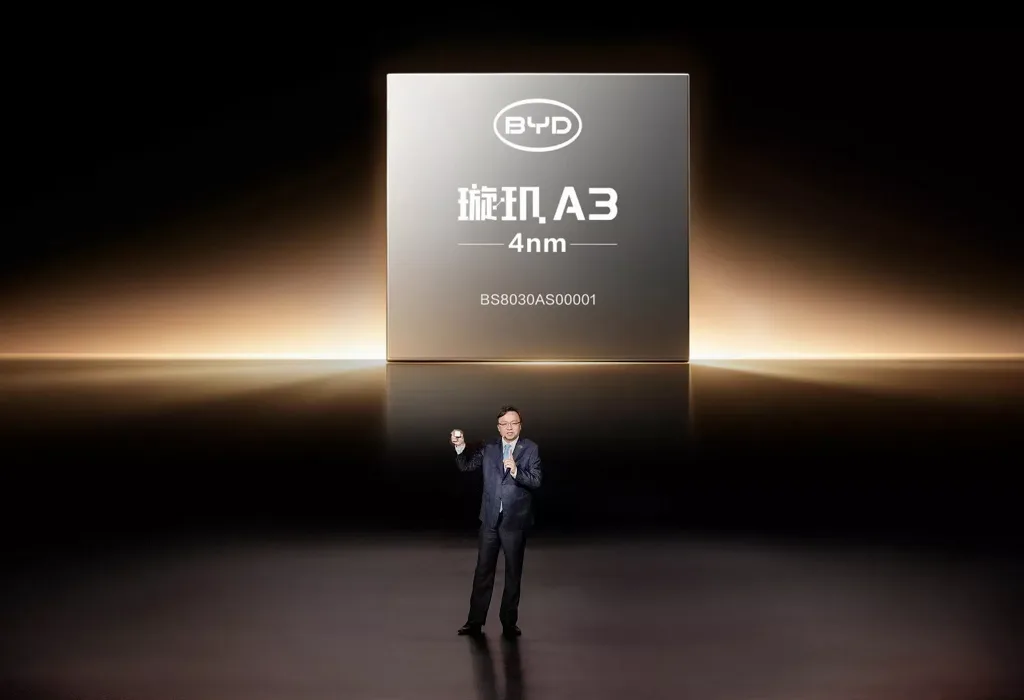
One of the most relevant technical announcements was the Xuanji A3, a driving chip developed by BYD using a 4 nm process. The company presents it as China’s first 4 nm automotive SoC focused on intelligent driving and says it supports L3 and L4 autonomous driving functions. In a three-chip configuration, the system can exceed 2,100 TOPS of computing power per vehicle, with 20% lower power consumption per TOPS than comparable products, according to BYD.
Source: BYD